
Middle-Office and Operations: The Infrastructure Powering All Firms
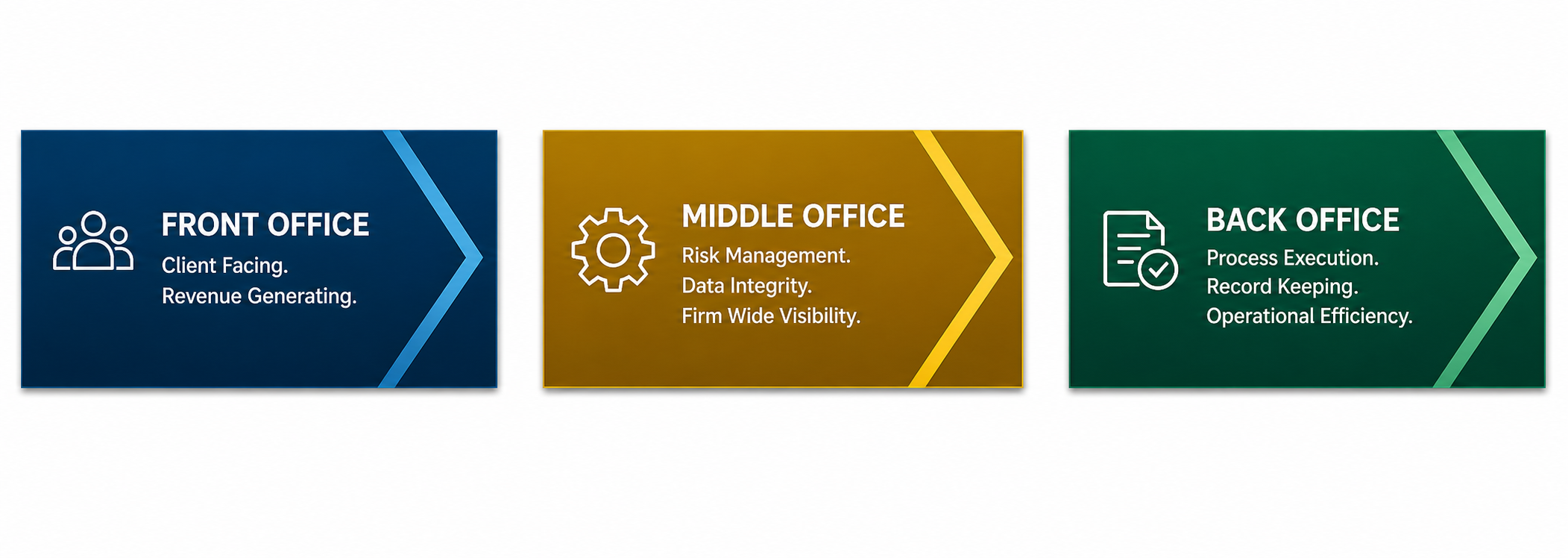
One of the most underrated roles in finance are those in the so-called middle and back-office. It is generally looked down by those in revenue-generating, front-office roles and written off as low-quality professionals, it's also seen as undesirable pathways at uni circles. While it's true that the work is much less interesting, is compensated much less and is much less prestigious/glamorous compared to front-office (FO) roles, it still offers a realistic launchpad into roles higher up the chain if one is determined and talented enough. These roles often receive a fraction of applications received by FO desks, making them much easier to attain.
In the high-octane trading floors of London, the deal-making corridors of Frankfurt and the fast-growing financial centres of Dubai and Paris, the real engine room of every investment bank, hedge fund and asset manager is rarely seen by outsiders. Middle-office and operations teams are the invisible infrastructure that ensures trades settle, risks are measured, capital is optimised and regulators stay satisfied. Without them, even the most brilliant front-office deal or trade would collapse. For graduates and career switchers across the UK and EMEA, middle-office and operations careers offer stable, well-paid paths with genuine influence, rapid progression and direct exposure to the heartbeat of global finance. This 2026 overview explains exactly what middle-office and operations roles involve in the UK and EMEA, the main career streams, qualifications, day-to-day realities, compensation, progression routes and emerging trends. Whether you are targeting a bulge-bracket bank in Canary Wharf or a fast-scaling fintech in Berlin, these functions remain among the smartest and most resilient entry points into high finance.
What Are Middle-Office and Back-Office Operations?
Middle-office sits between the revenue-generating front office (sales, trading, investment banking) and the pure processing back office. It focuses on risk management, product control, regulatory compliance and performance measurement. Operations (often called “ops”) handle the end-to-end lifecycle of trades and securities: confirmation, settlement, reconciliation, collateral management and client servicing. Together they form the critical infrastructure that:
- Prevents financial losses through accurate P&L and risk reporting
- Ensures regulatory compliance (EMIR, MiFID II, Basel III, SFTR)
- Supports capital efficiency and funding decisions
- Enables front-office teams to focus on client and market opportunities
Major Roles in Middle-Office and Operations in the UK & EMEA
The field offers wide variety across banks, funds and fintechs: 1. Product Control (P&L Attribution) Daily independent validation of trading desk profits and losses. The “eyes and ears” of senior management; highly quantitative and respected. 2. Market & Credit Risk Monitoring VaR, stress testing, counterparty exposure and limit breaches. Huge demand in London and Frankfurt as regulators tighten capital rules. 3. Trade Operations & Settlement Confirming, settling and reconciling equities, fixed income, derivatives and digital assets. London remains the European hub for complex OTC derivatives ops. 4. Collateral Management & Margining Managing cash and securities collateral under EMIR and uncleared margin rules — a growth area post-2022 regulatory changes. 5. Regulatory Reporting & Compliance Producing CFT, EMIR, SFTR, MiFID and Basel reports. Increasingly automated but still requires deep product knowledge. 6. Treasury & Liquidity Operations Funding desks, cash management and liquidity stress testing — critical since the 2023 banking stresses. 7. Data & Digital Operations Newest high-growth stream: building data pipelines, RPA bots and AI-driven reconciliation for banks and asset managers.
Education, Qualifications & Entry Routes Most entrants hold a bachelor’s degree (any subject, though finance, economics, maths or computer science helps). Top feeders include LSE, UCL, Warwick, Cass Business School and European universities such as Bocconi, ESSEC and Frankfurt School. Key qualifications that accelerate careers:
- CFA (Chartered Financial Analyst) – especially for risk and product control
- FRM (Financial Risk Manager) – gold standard for market and credit risk
- CAIA or IMC – useful for operations and asset management
- Firm-sponsored certifications in regulatory reporting or data analytics
A Day (and Peak Period) in the Life A typical day in London or Frankfurt might include:
- Morning P&L flash and exception reportingRisk limit monitoring and breach escalation
- Trade break investigation and client queries
- Running regulatory reports or liquidity dashboards
- Meetings with front office to explain new trade structures
- Building or refining Python/RPA processes
Career Progression & Exit Opportunities Progression is structured and merit-based:
- Years 1–2: Analyst / Junior Operator
- Years 3–5: Associate / Senior Analyst (post-qualification)
- Years 6–9: Vice President / Manager
- Years 10+: Director / Executive Director / Head of Function
- Front-office moves (many risk or product control professionals move to trading desks)
- Fintech and regtech startups
- Asset management middle-office
- Consulting (risk and regulatory practices)
- Senior operations leadership at private equity or hedge funds
Compensation in 2026 (UK Focus) London pays a clear premium; other UK and EMEA hubs (Frankfurt, Paris, Dubai) are 15–35% lower. Approximate ranges for investment banks and large funds (GBP, London):
- Graduate / Analyst: £38,000 – £55,000 + bonus (£5k–£12k)
- Associate (2–4 years): £55,000 – £80,000 + bonus
- Vice President: £85,000 – £130,000 + bonus
- Director: £140,000 – £200,000 + bonus
- Managing Director / Head of: £220,000 – £400,000+ (with carry in funds)
Challenges & Rewards
Challenges include tight deadlines, occasional blame when things go wrong and the pressure of regulatory scrutiny. However, the rewards are substantial: genuine business impact, intellectual variety, strong pay with lower burnout risk than front office, and the satisfaction of keeping multi-billion-pound institutions running smoothly every single day. Diversity programmes across banks have improved markedly, with targeted hiring for women, ethnic minorities and neurodiverse talent in operations and risk.
The Future of Middle-Office and Operations in the UK & EMEA
Automation and AI are transforming the space. Robotic process automation and machine-learning reconciliation tools have already cut manual work by 40–60% in many banks. Real-time risk platforms, blockchain-based settlement (especially for digital assets) and regtech solutions are creating new high-value roles. By 2028, skills in Python, SQL, data visualisation (Tableau/Power BI) and cloud platforms will be mandatory. ESG and climate risk reporting is another exploding area under UK and EU rules. Professionals who combine domain knowledge with technology fluency will command the highest premiums and fastest promotions.
How to Start Your Middle-Office or Operations Career in 2026
- Secure a strong 2:1 or First (or equivalent) with good numeracy. - Apply early for bank and fund graduate schemes and spring/summer internships. - Develop technical skills — learn Excel, SQL and basic Python via free online courses. - Prepare for interviews: expect brainteasers, risk scenarios and Excel tests. - Network on LinkedIn with alumni and attend virtual career events. - Consider CFA Level 1 or FRM Part 1 while still studying.
Final Thoughts Middle-office and operations are the unsung heroes that make modern finance possible. In the UK and EMEA — regions defined by sophisticated regulation, cross-border complexity and rapid digital change — these roles deliver stability, influence and genuine career longevity. Whether you spend a decade rising to head of function or use the experience as a springboard into trading, fintech or senior management, the technical grounding, market exposure and professional network you build will power your entire career. If you are detail-oriented, analytical, calm under pressure and want to be at the centre of finance without the 100-hour front-office weeks, middle-office and operations could be the perfect high-finance career for you in 2026 and beyond.


Middle-Office and Operations: The Infrastructure Powering All Firms
One of the most underrated roles in finance are those in the so-called middle and back-office. It is generally looked down by those in revenue-generating, front-office roles and written off as low-quality professionals, it's also seen as undesirable pathways at uni circles. While it's true that the work is much less interesting, is compensated much less and is much less prestigious/glamorous compared to front-office (FO) roles, it still offers a realistic launchpad into roles higher up the chain if one is determined and talented enough. These roles often receive a fraction of applications received by FO desks, making them much easier to attain.
In the high-octane trading floors of London, the deal-making corridors of Frankfurt and the fast-growing financial centres of Dubai and Paris, the real engine room of every investment bank, hedge fund and asset manager is rarely seen by outsiders. Middle-office and operations teams are the invisible infrastructure that ensures trades settle, risks are measured, capital is optimised and regulators stay satisfied. Without them, even the most brilliant front-office deal or trade would collapse. For graduates and career switchers across the UK and EMEA, middle-office and operations careers offer stable, well-paid paths with genuine influence, rapid progression and direct exposure to the heartbeat of global finance. This 2026 overview explains exactly what middle-office and operations roles involve in the UK and EMEA, the main career streams, qualifications, day-to-day realities, compensation, progression routes and emerging trends. Whether you are targeting a bulge-bracket bank in Canary Wharf or a fast-scaling fintech in Berlin, these functions remain among the smartest and most resilient entry points into high finance.
What Are Middle-Office and Back-Office Operations?
Middle-office sits between the revenue-generating front office (sales, trading, investment banking) and the pure processing back office. It focuses on risk management, product control, regulatory compliance and performance measurement. Operations (often called “ops”) handle the end-to-end lifecycle of trades and securities: confirmation, settlement, reconciliation, collateral management and client servicing. Together they form the critical infrastructure that:
- Prevents financial losses through accurate P&L and risk reporting
- Ensures regulatory compliance (EMIR, MiFID II, Basel III, SFTR)
- Supports capital efficiency and funding decisions
- Enables front-office teams to focus on client and market opportunities
Major Roles in Middle-Office and Operations in the UK & EMEA
The field offers wide variety across banks, funds and fintechs: 1. Product Control (P&L Attribution) Daily independent validation of trading desk profits and losses. The “eyes and ears” of senior management; highly quantitative and respected. 2. Market & Credit Risk Monitoring VaR, stress testing, counterparty exposure and limit breaches. Huge demand in London and Frankfurt as regulators tighten capital rules. 3. Trade Operations & Settlement Confirming, settling and reconciling equities, fixed income, derivatives and digital assets. London remains the European hub for complex OTC derivatives ops. 4. Collateral Management & Margining Managing cash and securities collateral under EMIR and uncleared margin rules — a growth area post-2022 regulatory changes. 5. Regulatory Reporting & Compliance Producing CFT, EMIR, SFTR, MiFID and Basel reports. Increasingly automated but still requires deep product knowledge. 6. Treasury & Liquidity Operations Funding desks, cash management and liquidity stress testing — critical since the 2023 banking stresses. 7. Data & Digital Operations Newest high-growth stream: building data pipelines, RPA bots and AI-driven reconciliation for banks and asset managers.
Education, Qualifications & Entry Routes Most entrants hold a bachelor’s degree (any subject, though finance, economics, maths or computer science helps). Top feeders include LSE, UCL, Warwick, Cass Business School and European universities such as Bocconi, ESSEC and Frankfurt School. Key qualifications that accelerate careers:
- CFA (Chartered Financial Analyst) – especially for risk and product control
- FRM (Financial Risk Manager) – gold standard for market and credit risk
- CAIA or IMC – useful for operations and asset management
- Firm-sponsored certifications in regulatory reporting or data analytics
A Day (and Peak Period) in the Life A typical day in London or Frankfurt might include:
- Morning P&L flash and exception reportingRisk limit monitoring and breach escalation
- Trade break investigation and client queries
- Running regulatory reports or liquidity dashboards
- Meetings with front office to explain new trade structures
- Building or refining Python/RPA processes
Career Progression & Exit Opportunities Progression is structured and merit-based:
- Years 1–2: Analyst / Junior Operator
- Years 3–5: Associate / Senior Analyst (post-qualification)
- Years 6–9: Vice President / Manager
- Years 10+: Director / Executive Director / Head of Function
- Front-office moves (many risk or product control professionals move to trading desks)
- Fintech and regtech startups
- Asset management middle-office
- Consulting (risk and regulatory practices)
- Senior operations leadership at private equity or hedge funds
Compensation in 2026 (UK Focus) London pays a clear premium; other UK and EMEA hubs (Frankfurt, Paris, Dubai) are 15–35% lower. Approximate ranges for investment banks and large funds (GBP, London):
- Graduate / Analyst: £38,000 – £55,000 + bonus (£5k–£12k)
- Associate (2–4 years): £55,000 – £80,000 + bonus
- Vice President: £85,000 – £130,000 + bonus
- Director: £140,000 – £200,000 + bonus
- Managing Director / Head of: £220,000 – £400,000+ (with carry in funds)
Challenges & Rewards
Challenges include tight deadlines, occasional blame when things go wrong and the pressure of regulatory scrutiny. However, the rewards are substantial: genuine business impact, intellectual variety, strong pay with lower burnout risk than front office, and the satisfaction of keeping multi-billion-pound institutions running smoothly every single day. Diversity programmes across banks have improved markedly, with targeted hiring for women, ethnic minorities and neurodiverse talent in operations and risk.
The Future of Middle-Office and Operations in the UK & EMEA
Automation and AI are transforming the space. Robotic process automation and machine-learning reconciliation tools have already cut manual work by 40–60% in many banks. Real-time risk platforms, blockchain-based settlement (especially for digital assets) and regtech solutions are creating new high-value roles. By 2028, skills in Python, SQL, data visualisation (Tableau/Power BI) and cloud platforms will be mandatory. ESG and climate risk reporting is another exploding area under UK and EU rules. Professionals who combine domain knowledge with technology fluency will command the highest premiums and fastest promotions.
How to Start Your Middle-Office or Operations Career in 2026
- Secure a strong 2:1 or First (or equivalent) with good numeracy. - Apply early for bank and fund graduate schemes and spring/summer internships. - Develop technical skills — learn Excel, SQL and basic Python via free online courses. - Prepare for interviews: expect brainteasers, risk scenarios and Excel tests. - Network on LinkedIn with alumni and attend virtual career events. - Consider CFA Level 1 or FRM Part 1 while still studying.
Final Thoughts Middle-office and operations are the unsung heroes that make modern finance possible. In the UK and EMEA — regions defined by sophisticated regulation, cross-border complexity and rapid digital change — these roles deliver stability, influence and genuine career longevity. Whether you spend a decade rising to head of function or use the experience as a springboard into trading, fintech or senior management, the technical grounding, market exposure and professional network you build will power your entire career. If you are detail-oriented, analytical, calm under pressure and want to be at the centre of finance without the 100-hour front-office weeks, middle-office and operations could be the perfect high-finance career for you in 2026 and beyond.