
The Largest M&A Deal of All Time
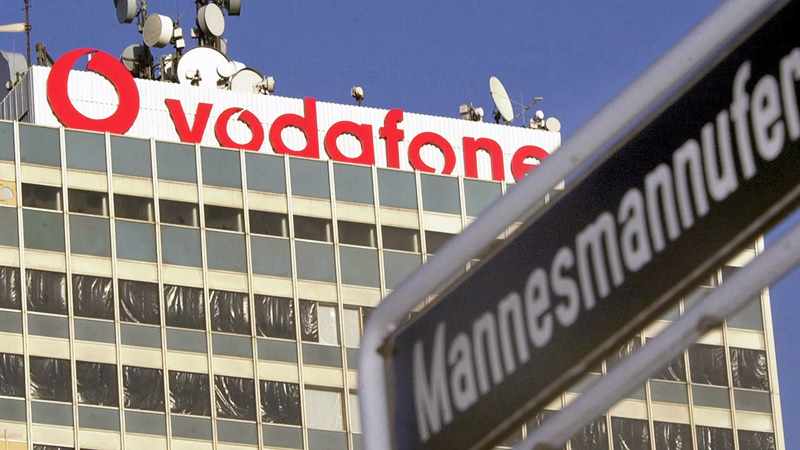
The largest merger and acquisition (M&A) deal of all time remains the hostile takeover of Mannesmann AG by Vodafone AirTouch PLC in 1999–2000, a landmark transaction that reshaped the global telecommunications landscape and set a record that has stood for over two decades.
The Record-Breaking Deal
In late 1999, British telecom giant Vodafone AirTouch (formed after Vodafone's earlier acquisition of AirTouch Communications) launched an audacious bid for Mannesmann AG, a German industrial conglomerate with significant telecommunications assets. What began as a rejected offer escalated into one of the most dramatic corporate battles in history.Mannesmann, originally a steel and engineering firm founded in 1890, had transformed into a major player in mobile communications through aggressive expansions, including the acquisition of British operator Orange. Vodafone, eager to dominate the burgeoning mobile market in Europe, saw Mannesmann's assets as a perfect complement. After Mannesmann's management fiercely resisted—labeling the approach "hostile" and unprecedented in Europe's more consensus-driven corporate culture—Vodafone went directly to shareholders.
The breakthrough came in February 2000 when Mannesmann's board relented. The final all-stock deal valued Mannesmann at approximately $183 billion (with some sources citing figures up to $202.8 billion depending on adjustments for debt and market fluctuations at closing). This made it the largest corporate acquisition ever recorded, surpassing the previous high set by AOL's $165 billion merger with Time Warner just weeks earlier.
The transaction created a telecom behemoth with operations across Europe and beyond, briefly positioning Vodafone as the world's largest mobile operator by subscribers. It also marked the first successful hostile takeover of a major German company, challenging traditional Rhineland capitalism norms and signaling the globalization of M&A activity.
Why This Deal Stands Out
Several factors made the Vodafone-Mannesmann transaction extraordinary:- Scale and Hostility — At the time, hostile takeovers were rare in Europe, especially for such a prominent firm. Vodafone's persistence involved massive share exchanges and direct appeals to Mannesmann shareholders, who ultimately voted with their wallets amid the dot-com boom's inflated valuations.
- Timing in the Telecom Bubble — The late 1990s saw explosive growth in mobile technology. Investors poured money into telecom stocks, driving sky-high valuations. The deal closed at the peak of this frenzy, just before the bubble burst in 2000–2001, which later led to massive write-downs for many players.
- Strategic Impact — Post-acquisition, Vodafone gained control of Mannesmann's vast European mobile networks, accelerating its international expansion. Mannesmann's Orange stake was later divested to France Télécom for $46 billion (another record at the time) to satisfy regulatory concerns.
How It Compares to Other Mega-Deals
While the Vodafone-Mannesmann deal holds the top spot in nominal terms for cross-border acquisitions in Western markets, some caveats exist in broader rankings:- Certain domestic Chinese mergers, like the 2017 Shenhua Group–China Guodian Corporation tie-up (valued around $278 billion), are sometimes cited as larger but represent state-directed consolidations rather than traditional market-driven M&A.
- Iconic deals like AOL-Time Warner (2000, ~$165 billion) became infamous for their post-merger failure, with massive impairments.
- More recent blockbuster transactions—such as Verizon's 2013 buyback of Vodafone's stake in Verizon Wireless (~$130 billion), or various tech and energy megadeals—have fallen short of the 1999–2000 record.
Legacy and Lessons
The Vodafone-Mannesmann saga highlighted the power of shareholder activism in cross-border deals and accelerated consolidation in telecom. However, it also foreshadowed risks: Vodafone faced enormous debt from the acquisition, leading to asset sales and strategic shifts in subsequent years. The dot-com crash soon after eroded much of the perceived value.Today, the deal serves as a benchmark for ambition in M&A. In an era of AI-driven consolidations, private equity mega-buyouts, and renewed megadeal momentum (with global volumes surging in 2025–2026), it reminds us that the largest transactions often occur at market peaks—and their true success unfolds over decades, not headlines.


The Largest M&A Deal of All Time
The largest merger and acquisition (M&A) deal of all time remains the hostile takeover of Mannesmann AG by Vodafone AirTouch PLC in 1999–2000, a landmark transaction that reshaped the global telecommunications landscape and set a record that has stood for over two decades.
The Record-Breaking Deal
In late 1999, British telecom giant Vodafone AirTouch (formed after Vodafone's earlier acquisition of AirTouch Communications) launched an audacious bid for Mannesmann AG, a German industrial conglomerate with significant telecommunications assets. What began as a rejected offer escalated into one of the most dramatic corporate battles in history.Mannesmann, originally a steel and engineering firm founded in 1890, had transformed into a major player in mobile communications through aggressive expansions, including the acquisition of British operator Orange. Vodafone, eager to dominate the burgeoning mobile market in Europe, saw Mannesmann's assets as a perfect complement. After Mannesmann's management fiercely resisted—labeling the approach "hostile" and unprecedented in Europe's more consensus-driven corporate culture—Vodafone went directly to shareholders.
The breakthrough came in February 2000 when Mannesmann's board relented. The final all-stock deal valued Mannesmann at approximately $183 billion (with some sources citing figures up to $202.8 billion depending on adjustments for debt and market fluctuations at closing). This made it the largest corporate acquisition ever recorded, surpassing the previous high set by AOL's $165 billion merger with Time Warner just weeks earlier.
The transaction created a telecom behemoth with operations across Europe and beyond, briefly positioning Vodafone as the world's largest mobile operator by subscribers. It also marked the first successful hostile takeover of a major German company, challenging traditional Rhineland capitalism norms and signaling the globalization of M&A activity.
Why This Deal Stands Out
Several factors made the Vodafone-Mannesmann transaction extraordinary:- Scale and Hostility — At the time, hostile takeovers were rare in Europe, especially for such a prominent firm. Vodafone's persistence involved massive share exchanges and direct appeals to Mannesmann shareholders, who ultimately voted with their wallets amid the dot-com boom's inflated valuations.
- Timing in the Telecom Bubble — The late 1990s saw explosive growth in mobile technology. Investors poured money into telecom stocks, driving sky-high valuations. The deal closed at the peak of this frenzy, just before the bubble burst in 2000–2001, which later led to massive write-downs for many players.
- Strategic Impact — Post-acquisition, Vodafone gained control of Mannesmann's vast European mobile networks, accelerating its international expansion. Mannesmann's Orange stake was later divested to France Télécom for $46 billion (another record at the time) to satisfy regulatory concerns.
How It Compares to Other Mega-Deals
While the Vodafone-Mannesmann deal holds the top spot in nominal terms for cross-border acquisitions in Western markets, some caveats exist in broader rankings:- Certain domestic Chinese mergers, like the 2017 Shenhua Group–China Guodian Corporation tie-up (valued around $278 billion), are sometimes cited as larger but represent state-directed consolidations rather than traditional market-driven M&A.
- Iconic deals like AOL-Time Warner (2000, ~$165 billion) became infamous for their post-merger failure, with massive impairments.
- More recent blockbuster transactions—such as Verizon's 2013 buyback of Vodafone's stake in Verizon Wireless (~$130 billion), or various tech and energy megadeals—have fallen short of the 1999–2000 record.
Legacy and Lessons
The Vodafone-Mannesmann saga highlighted the power of shareholder activism in cross-border deals and accelerated consolidation in telecom. However, it also foreshadowed risks: Vodafone faced enormous debt from the acquisition, leading to asset sales and strategic shifts in subsequent years. The dot-com crash soon after eroded much of the perceived value.Today, the deal serves as a benchmark for ambition in M&A. In an era of AI-driven consolidations, private equity mega-buyouts, and renewed megadeal momentum (with global volumes surging in 2025–2026), it reminds us that the largest transactions often occur at market peaks—and their true success unfolds over decades, not headlines.