
Introduction to Quantitative Finance
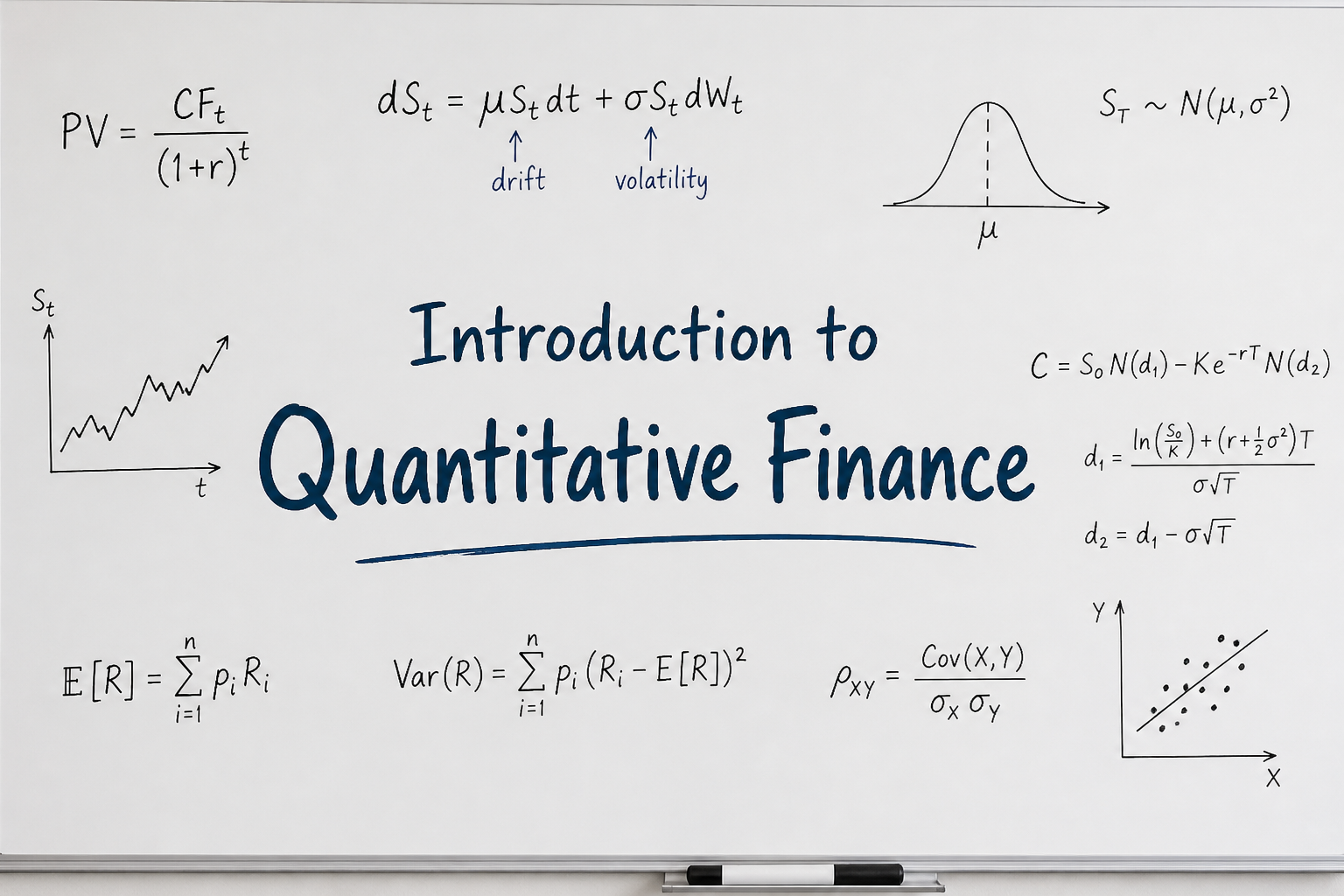
Quantitative finance, often referred to as "quant finance," is a dynamic field that merges advanced mathematics, statistics, computer science, and financial theory to solve complex problems in the financial markets. It emerged prominently in the 1980s with the development of computational methods for pricing derivatives and has since evolved to encompass data science, machine learning, and algorithmic trading. Today, quants—professionals in this domain—play central roles in investment banks, hedge funds, asset management firms, and fintech companies. They develop models to predict market movements, manage risks, and optimize trading strategies, contributing to efficient capital allocation and economic stability. The appeal of quant finance careers lies in their intellectual rigor, high compensation—entry-level salaries often exceed $225,000—and opportunities for innovation in a fast-paced environment. With the rise of AI and big data, the demand for quants continues to grow, making it an attractive path for STEM graduates.
Key Roles in Quantitative Finance
Quant finance offers a variety of roles, each emphasizing different aspects of modeling, analysis, and implementation. Quantitative analysts (quants) design and implement mathematical models for pricing securities, forecasting trends, and assessing risks. For instance, in investment banks, they might focus on derivatives pricing using models like Black-Scholes, while in hedge funds, they develop strategies for statistical arbitrage or high-frequency trading.Common positions include:
- Quant Traders: These professionals create algorithmic trading systems, executing trades based on statistical models. They handle market-making, optimizing execution to minimize costs and risks, often in proprietary trading firms like Jane Street or Citadel Securities. Quantblueprint
- Quant Researchers: Focused on innovation, they build predictive models using machine learning to analyze vast datasets, such as historical prices or news sentiment, to generate alpha (excess returns). This role is prevalent in buy-side firms like Two Sigma. Quantstart
- Quant Developers: They engineer the software infrastructure for trading platforms, emphasizing low-latency programming in languages like C++ to support high-frequency operations. Quantblueprint
- Risk Analysts: In middle-office functions, they compute metrics like credit valuation adjustment (CVA) to evaluate counterparty risks, ensuring compliance with regulations like Dodd-Frank. Other roles span fixed income analysts, who model bonds and interest rates, and portfolio managers, who use optimization techniques for asset allocation.Apply.mscf.cmu +1
Required Skills and Education
Success in quant finance demands a robust technical foundation. Core skills include advanced mathematics—probability, stochastic calculus, linear algebra, and optimization—and statistics for inference and econometrics. Programming proficiency is essential, with Python for data analysis and machine learning (using libraries like NumPy, Pandas, and TensorFlow), C++ for performance-critical applications, and SQL for database management. Financial knowledge covers topics like Modern Portfolio Theory, derivatives pricing, market microstructure, and risk management.Educationally, most entrants hold STEM bachelor's degrees in mathematics, computer science, physics, or engineering. A master's in quantitative finance, financial engineering, or computational finance is often preferred, providing specialized training in stochastic processes, simulation, and corporate finance. Programs like Carnegie Mellon's Master of Science in Computational Finance (MSCF) integrate math, stats, and programming, with strong industry connections. PhDs are advantageous for research-intensive roles, demonstrating deep expertise in areas like applied math or machine learning. Certifications, such as the Certificate in Quantitative Finance (CQF), offer practical skills in modeling and Python, ideal for working professionals. Soft skills like communication and teamwork are crucial for collaborating with traders and presenting insights.
How to Get Started
Breaking into quant finance requires strategic preparation. Begin by building a strong academic base in STEM subjects. Pursue relevant coursework or online resources to master key concepts. Gain practical experience through projects, such as backtesting trading strategies in Python or optimizing portfolios via Monte Carlo simulations. Participate in competitions like Kaggle's financial modeling challenges or QuantConnect's algorithmic trading contests to build a portfolio.Secure internships at financial firms to apply skills in real settings. Networking is vital—attend conferences, join communities like QuantNet or Wilmott Forums, and leverage LinkedIn for connections. Tailor your resume to highlight technical projects and quantitative achievements. Prepare for rigorous interviews testing brain teasers, coding challenges, and financial puzzles. Apply early to top firms like D.E. Shaw or Optiver, where internships often lead to full-time offers.
Career Progression and Challenges
Career paths in quant finance are merit-based, with rapid advancement possible. Entry-level roles evolve into senior positions like lead researcher or chief risk officer, with salaries climbing to over $500,000 for experienced professionals. Progression involves publishing research, leading teams, or even starting fintech ventures. However, challenges abound: the field is highly competitive, with demanding interviews and long hours. Model limitations, as exposed in the 2007-2010 crisis, require ethical judgment and skepticism. Regulatory changes and market volatility add complexity, demanding continuous learning.Future Outlook in 2025 and Beyond
As of 2025, quant finance is thriving amid AI advancements and data proliferation. Roles incorporating machine learning for predictive analytics and algorithmic execution are expanding, with projected job growth in financial analysis (6%) and operations (21%). Fintech innovations and sustainable finance models create new opportunities, but quants must adapt to ethical AI use and regulatory scrutiny. The field's intellectual and financial rewards make it resilient, with strong prospects in banking, insurance, and consulting.Conclusion
Quantitative finance careers offer a blend of intellectual challenge, innovation, and lucrative rewards for those with strong analytical skills. By pursuing the right education, honing technical expertise, and gaining hands-on experience, aspiring quants can thrive in this evolving industry. Whether modeling risks or trading algorithms, the impact of quants on global finance is profound, promising a fulfilling path for dedicated professionals.




Introduction to Quantitative Finance
Quantitative finance, often referred to as "quant finance," is a dynamic field that merges advanced mathematics, statistics, computer science, and financial theory to solve complex problems in the financial markets. It emerged prominently in the 1980s with the development of computational methods for pricing derivatives and has since evolved to encompass data science, machine learning, and algorithmic trading. Today, quants—professionals in this domain—play central roles in investment banks, hedge funds, asset management firms, and fintech companies. They develop models to predict market movements, manage risks, and optimize trading strategies, contributing to efficient capital allocation and economic stability. The appeal of quant finance careers lies in their intellectual rigor, high compensation—entry-level salaries often exceed $225,000—and opportunities for innovation in a fast-paced environment. With the rise of AI and big data, the demand for quants continues to grow, making it an attractive path for STEM graduates.
Key Roles in Quantitative Finance
Quant finance offers a variety of roles, each emphasizing different aspects of modeling, analysis, and implementation. Quantitative analysts (quants) design and implement mathematical models for pricing securities, forecasting trends, and assessing risks. For instance, in investment banks, they might focus on derivatives pricing using models like Black-Scholes, while in hedge funds, they develop strategies for statistical arbitrage or high-frequency trading.Common positions include:
- Quant Traders: These professionals create algorithmic trading systems, executing trades based on statistical models. They handle market-making, optimizing execution to minimize costs and risks, often in proprietary trading firms like Jane Street or Citadel Securities. Quantblueprint
- Quant Researchers: Focused on innovation, they build predictive models using machine learning to analyze vast datasets, such as historical prices or news sentiment, to generate alpha (excess returns). This role is prevalent in buy-side firms like Two Sigma. Quantstart
- Quant Developers: They engineer the software infrastructure for trading platforms, emphasizing low-latency programming in languages like C++ to support high-frequency operations. Quantblueprint
- Risk Analysts: In middle-office functions, they compute metrics like credit valuation adjustment (CVA) to evaluate counterparty risks, ensuring compliance with regulations like Dodd-Frank. Other roles span fixed income analysts, who model bonds and interest rates, and portfolio managers, who use optimization techniques for asset allocation.Apply.mscf.cmu +1
Required Skills and Education
Success in quant finance demands a robust technical foundation. Core skills include advanced mathematics—probability, stochastic calculus, linear algebra, and optimization—and statistics for inference and econometrics. Programming proficiency is essential, with Python for data analysis and machine learning (using libraries like NumPy, Pandas, and TensorFlow), C++ for performance-critical applications, and SQL for database management. Financial knowledge covers topics like Modern Portfolio Theory, derivatives pricing, market microstructure, and risk management.Educationally, most entrants hold STEM bachelor's degrees in mathematics, computer science, physics, or engineering. A master's in quantitative finance, financial engineering, or computational finance is often preferred, providing specialized training in stochastic processes, simulation, and corporate finance. Programs like Carnegie Mellon's Master of Science in Computational Finance (MSCF) integrate math, stats, and programming, with strong industry connections. PhDs are advantageous for research-intensive roles, demonstrating deep expertise in areas like applied math or machine learning. Certifications, such as the Certificate in Quantitative Finance (CQF), offer practical skills in modeling and Python, ideal for working professionals. Soft skills like communication and teamwork are crucial for collaborating with traders and presenting insights.
How to Get Started
Breaking into quant finance requires strategic preparation. Begin by building a strong academic base in STEM subjects. Pursue relevant coursework or online resources to master key concepts. Gain practical experience through projects, such as backtesting trading strategies in Python or optimizing portfolios via Monte Carlo simulations. Participate in competitions like Kaggle's financial modeling challenges or QuantConnect's algorithmic trading contests to build a portfolio.Secure internships at financial firms to apply skills in real settings. Networking is vital—attend conferences, join communities like QuantNet or Wilmott Forums, and leverage LinkedIn for connections. Tailor your resume to highlight technical projects and quantitative achievements. Prepare for rigorous interviews testing brain teasers, coding challenges, and financial puzzles. Apply early to top firms like D.E. Shaw or Optiver, where internships often lead to full-time offers.
Career Progression and Challenges
Career paths in quant finance are merit-based, with rapid advancement possible. Entry-level roles evolve into senior positions like lead researcher or chief risk officer, with salaries climbing to over $500,000 for experienced professionals. Progression involves publishing research, leading teams, or even starting fintech ventures. However, challenges abound: the field is highly competitive, with demanding interviews and long hours. Model limitations, as exposed in the 2007-2010 crisis, require ethical judgment and skepticism. Regulatory changes and market volatility add complexity, demanding continuous learning.Future Outlook in 2025 and Beyond
As of 2025, quant finance is thriving amid AI advancements and data proliferation. Roles incorporating machine learning for predictive analytics and algorithmic execution are expanding, with projected job growth in financial analysis (6%) and operations (21%). Fintech innovations and sustainable finance models create new opportunities, but quants must adapt to ethical AI use and regulatory scrutiny. The field's intellectual and financial rewards make it resilient, with strong prospects in banking, insurance, and consulting.Conclusion
Quantitative finance careers offer a blend of intellectual challenge, innovation, and lucrative rewards for those with strong analytical skills. By pursuing the right education, honing technical expertise, and gaining hands-on experience, aspiring quants can thrive in this evolving industry. Whether modeling risks or trading algorithms, the impact of quants on global finance is profound, promising a fulfilling path for dedicated professionals.