
Big 4 vs Bulge-Bracket Investment Banking
Introduction
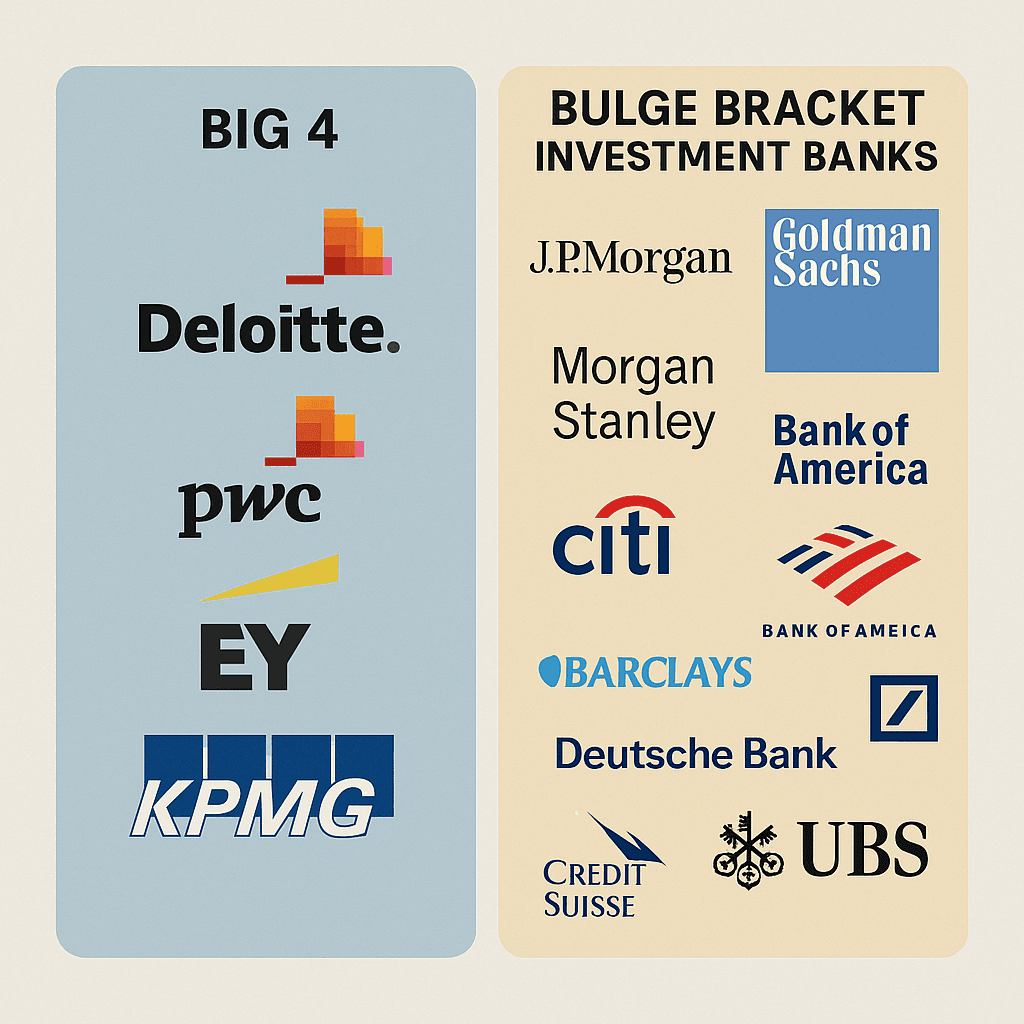
The financial services sector hosts two powerhouse groups: the Big 4 accounting firms—Deloitte, PwC, EY, and KPMG—and the Bulge Bracket investment banks like Goldman Sachs, JPMorgan Chase, Morgan Stanley, Citigroup, Bank of America Merrill Lynch, Barclays, and Deutsche Bank. Big 4 firms dominate audit, tax, risk advisory, and consulting, treating investment banking as a secondary arm focused on mid-market transactions. Bulge Bracket banks, by contrast, specialize in massive, high-stakes deals with full-spectrum financial services backed by enormous balance sheets.
These distinctions influence everything from career trajectories to client strategies and deal execution. Aspiring bankers, corporate executives, and students must grasp these nuances to navigate opportunities effectively. This in-depth analysis covers definitions, services, compensation, culture, exit paths, and future trends.
What Are Bulge Bracket Banks?
Bulge Bracket (BB) banks form the elite tier of global investment banking, defined by their scale, diversification, and market dominance. Named for their "bulging" market share on league tables, these institutions lead in mergers & acquisitions (M&A), initial public offerings (IPOs), debt/equity underwriting, and advisory for trillion-dollar entities.
Key players include Goldman Sachs (known for M&A prowess), JPMorgan (debt capital markets leader), Morgan Stanley (equity underwriting specialist), and Citigroup (global emerging markets focus). They operate hundreds of offices worldwide, employing tens of thousands with balance sheets exceeding $1 trillion each, enabling proprietary lending, trading, and risk-taking absent in advisory-only firms.
BB banks advise Fortune 500 CEOs, sovereign wealth funds, and governments on transformative deals like the $69 billion Microsoft–Activision merger or mega-IPOs. Their research arms provide market intelligence, while sales & trading desks ensure liquidity. This integrated model creates unmatched firepower for complex, cross-border transactions.
Big 4 Firms in Investment Banking Context
The Big 4 originated as auditors but expanded into transaction advisory via dedicated corporate finance (CF) and deals teams. Services encompass M&A advisory, financial due diligence (FDD), valuations, restructuring, post-merger integration, and carve-outs—often bundled with tax or consulting.
Unlike BB pure-plays, Big 4 IB is "supplemental," targeting lower middle-market deals ($100–500M EBITDA targets) for private equity (PE), venture capital (VC)-backed firms, and regional corporates. Internal "Chinese walls" prevent audit conflicts, ensuring independence.
They lead in deal volume, not value, excelling in high-throughput advisory where BB fees prove uneconomical. For instance, a $50M startup acquisition suits Big 4 economics, while BB chases $10B+ mandates.
Core Differences: Services and Deal Landscape
| Aspect | Bulge Bracket Banks | Big 4 Firms |
|---|---|---|
| Core Services | IB advisory, underwriting, S&T, research, asset mgmt, lending | M&A advisory, valuation, FDD, tax/integration |
| Deal Size | $1B+ mega-deals (global M&A, jumbo IPOs) | $100–500M mid-market; volume-focused |
| Clients | Fortune 500, governments, institutions | Mid-caps, PE/VC funds, startups |
| Balance Sheet | Massive ($1T+); underwriting + lending capability | None; advisory-only |
Compensation, Hours, and Work Culture
BB compensation is significantly higher: first-year analysts earn $110K base + $100K+ bonuses (total ~$220K), scaling to VP levels at $500K+ and MDs in the multimillions. Hours average 80–100 per week, with all-nighters common during live deals.
Big 4 pays solidly but lower—analysts earn $80–100K base + 20–50% bonuses (~$120–150K total), while seniors reach $200–400K. Hours typically run 50–70 per week, offering stronger work-life balance. Culture also differs: BB’s hierarchical, high-pressure environment offers elite networking but high burnout; Big 4 promotes collaboration and stability.
- BB Pros: Sky-high pay, brand prestige, mega-deal experience
- BB Cons: Brutal hours, bureaucracy
- Big 4 Pros: Work-life balance, broad skill development, high deal volume
- Big 4 Cons: Lower pay, less global prestige
BB experience accelerates careers: 2–3 years often leads to mega-fund PE (KKR, Blackstone), hedge funds, or corporate development roles at major tech companies. Employers value BB training for modeling, structuring, and billion-dollar deal exposure.
Big 4 builds strong foundations for mid-market PE, corporate development, or boutique IB laterals. Internationally (e.g., Australia, UK), Big 4 → BB transitions are easier; in the U.S., MBAs or additional networking may be required. Both paths develop financial modeling and client skills, but BB opens the highest-tier exits faster.
Long-term, BB MDs may earn $5–10M+ annually; Big 4 partners typically earn $1–2M with equity stakes.
Client Dynamics and Market Positioning
BB firms nurture C-suite relationships built over decades, offering unparalleled capital markets access and structuring capabilities. Their global resources make them the default choice for large-scale transformations.
Big 4 excels in hands-on advisory, leveraging audit insights to dominate diligence and integration. They top global deal-volume rankings and frequently co-advise with BBs.
Regulatory, Structural, and Risk Factors
BB banks operate under stringent regulations (Volcker Rule, Dodd-Frank) as deposit-taking institutions. Big 4 faces lighter regulatory burden but enforces strict audit independence.
BB scale leads to operational bureaucracy; Big 4 typically maintains flatter organizational structures.
Emerging Trends and Strategic Advice
The private equity boom fuels mid-market deal flow, benefiting Big 4. BB banks increasingly target ESG, fintech, and AI-related deals. Hybrid models are forming, with Big 4 acquiring boutique banks to expand reach.
Career choice depends on priorities: BB for maximum pay/prestige and accelerated exits; Big 4 for balanced lifestyle and broader advisory exposure. Both demand excellence amid intensifying talent competition.
Conclusion
Bulge Brackets dominate mega-deals with unmatched financial firepower, while Big 4 firms command the mid-market through high-volume, holistic advisory. The optimal path depends on whether one prioritizes prestige and compensation or stability and versatility.


Big 4 vs Bulge-Bracket Investment Banking
Introduction
The financial services sector hosts two powerhouse groups: the Big 4 accounting firms—Deloitte, PwC, EY, and KPMG—and the Bulge Bracket investment banks like Goldman Sachs, JPMorgan Chase, Morgan Stanley, Citigroup, Bank of America Merrill Lynch, Barclays, and Deutsche Bank. Big 4 firms dominate audit, tax, risk advisory, and consulting, treating investment banking as a secondary arm focused on mid-market transactions. Bulge Bracket banks, by contrast, specialize in massive, high-stakes deals with full-spectrum financial services backed by enormous balance sheets.
These distinctions influence everything from career trajectories to client strategies and deal execution. Aspiring bankers, corporate executives, and students must grasp these nuances to navigate opportunities effectively. This in-depth analysis covers definitions, services, compensation, culture, exit paths, and future trends.
What Are Bulge Bracket Banks?
Bulge Bracket (BB) banks form the elite tier of global investment banking, defined by their scale, diversification, and market dominance. Named for their "bulging" market share on league tables, these institutions lead in mergers & acquisitions (M&A), initial public offerings (IPOs), debt/equity underwriting, and advisory for trillion-dollar entities.
Key players include Goldman Sachs (known for M&A prowess), JPMorgan (debt capital markets leader), Morgan Stanley (equity underwriting specialist), and Citigroup (global emerging markets focus). They operate hundreds of offices worldwide, employing tens of thousands with balance sheets exceeding $1 trillion each, enabling proprietary lending, trading, and risk-taking absent in advisory-only firms.
BB banks advise Fortune 500 CEOs, sovereign wealth funds, and governments on transformative deals like the $69 billion Microsoft–Activision merger or mega-IPOs. Their research arms provide market intelligence, while sales & trading desks ensure liquidity. This integrated model creates unmatched firepower for complex, cross-border transactions.
Big 4 Firms in Investment Banking Context
The Big 4 originated as auditors but expanded into transaction advisory via dedicated corporate finance (CF) and deals teams. Services encompass M&A advisory, financial due diligence (FDD), valuations, restructuring, post-merger integration, and carve-outs—often bundled with tax or consulting.
Unlike BB pure-plays, Big 4 IB is "supplemental," targeting lower middle-market deals ($100–500M EBITDA targets) for private equity (PE), venture capital (VC)-backed firms, and regional corporates. Internal "Chinese walls" prevent audit conflicts, ensuring independence.
They lead in deal volume, not value, excelling in high-throughput advisory where BB fees prove uneconomical. For instance, a $50M startup acquisition suits Big 4 economics, while BB chases $10B+ mandates.
Core Differences: Services and Deal Landscape
| Aspect | Bulge Bracket Banks | Big 4 Firms |
|---|---|---|
| Core Services | IB advisory, underwriting, S&T, research, asset mgmt, lending | M&A advisory, valuation, FDD, tax/integration |
| Deal Size | $1B+ mega-deals (global M&A, jumbo IPOs) | $100–500M mid-market; volume-focused |
| Clients | Fortune 500, governments, institutions | Mid-caps, PE/VC funds, startups |
| Balance Sheet | Massive ($1T+); underwriting + lending capability | None; advisory-only |
Compensation, Hours, and Work Culture
BB compensation is significantly higher: first-year analysts earn $110K base + $100K+ bonuses (total ~$220K), scaling to VP levels at $500K+ and MDs in the multimillions. Hours average 80–100 per week, with all-nighters common during live deals.
Big 4 pays solidly but lower—analysts earn $80–100K base + 20–50% bonuses (~$120–150K total), while seniors reach $200–400K. Hours typically run 50–70 per week, offering stronger work-life balance. Culture also differs: BB’s hierarchical, high-pressure environment offers elite networking but high burnout; Big 4 promotes collaboration and stability.
- BB Pros: Sky-high pay, brand prestige, mega-deal experience
- BB Cons: Brutal hours, bureaucracy
- Big 4 Pros: Work-life balance, broad skill development, high deal volume
- Big 4 Cons: Lower pay, less global prestige
BB experience accelerates careers: 2–3 years often leads to mega-fund PE (KKR, Blackstone), hedge funds, or corporate development roles at major tech companies. Employers value BB training for modeling, structuring, and billion-dollar deal exposure.
Big 4 builds strong foundations for mid-market PE, corporate development, or boutique IB laterals. Internationally (e.g., Australia, UK), Big 4 → BB transitions are easier; in the U.S., MBAs or additional networking may be required. Both paths develop financial modeling and client skills, but BB opens the highest-tier exits faster.
Long-term, BB MDs may earn $5–10M+ annually; Big 4 partners typically earn $1–2M with equity stakes.
Client Dynamics and Market Positioning
BB firms nurture C-suite relationships built over decades, offering unparalleled capital markets access and structuring capabilities. Their global resources make them the default choice for large-scale transformations.
Big 4 excels in hands-on advisory, leveraging audit insights to dominate diligence and integration. They top global deal-volume rankings and frequently co-advise with BBs.
Regulatory, Structural, and Risk Factors
BB banks operate under stringent regulations (Volcker Rule, Dodd-Frank) as deposit-taking institutions. Big 4 faces lighter regulatory burden but enforces strict audit independence.
BB scale leads to operational bureaucracy; Big 4 typically maintains flatter organizational structures.
Emerging Trends and Strategic Advice
The private equity boom fuels mid-market deal flow, benefiting Big 4. BB banks increasingly target ESG, fintech, and AI-related deals. Hybrid models are forming, with Big 4 acquiring boutique banks to expand reach.
Career choice depends on priorities: BB for maximum pay/prestige and accelerated exits; Big 4 for balanced lifestyle and broader advisory exposure. Both demand excellence amid intensifying talent competition.
Conclusion
Bulge Brackets dominate mega-deals with unmatched financial firepower, while Big 4 firms command the mid-market through high-volume, holistic advisory. The optimal path depends on whether one prioritizes prestige and compensation or stability and versatility.