
LOG IN
SIGN UP
Sign In
Forgot password?
Don't have an account?Create an account
or
Join Canary Wharfian
or
Back to Investment Banking articles
So... WTF is a Transaction?
by Canary Wharfian•February 11th 2026
Join the conversation
You've probably heard the word "transaction" thrown around like confetti at a trading floor celebration. But what does it actually mean? Not in the dictionary sense — in the real, practical, "this is what bankers actually do" sense. Let's break it down.
The Simple Version
A transaction is a major financial event where a company buys, sells, combines, or raises something of value — like ownership or capital — generally for strategic reasons. Put another way, it is a major event in a company's life, the equivalent of a person buying a house, borrowing money, or selling their car. These are not everyday occurrences. They are defining moments that reshape what a company is, what it owns, and how it funds its future.When people in investment banking say they "work on transactions," they mean they are advising on or executing one of these landmark events. It might be helping a tech startup go public, advising a pharmaceutical giant on acquiring a competitor, or structuring a billion-pound bond issuance for a sovereign government. The common thread is that something significant is changing hands — ownership, capital, risk — and professionals are brought in to make sure it happens smoothly, efficiently, and on the best possible terms.Why Do Companies Need Help?
For major decisions where large amounts of money and value are at stake, decision-makers commonly seek advice. That's intuitive — you wouldn't perform surgery on yourself, and you probably wouldn't sell a billion-pound business without expert guidance either. The larger the transaction, the more specialised that advice tends to be. Why? Because marginally improving the result of a transaction with specialist expertise is enormously valuable.Consider this: it's not worth spending £1 million on advisors to sell a £3 million house, because they are unlikely to add value in excess of their fees. But if you are selling a business worth £1 billion, and your £1 million advisor could improve the terms of the sale by just 1%, they could generate £10 million in value for their client. That's a high-return investment in quality advice for the business owner. This is precisely why investment banks exist — and why they command the fees they do.The Two Big Buckets: M&A and Capital Markets
Broadly speaking, transactions in investment banking fall into two major categories: mergers and acquisitions (M&A) on one side, and capital markets on the other.M&A is what most people picture when they think of investment banking. One company buying another. Two firms merging. A private equity fund taking a business private. These are advisory-driven transactions where bankers help clients navigate the strategic, financial, and procedural complexity of combining or separating businesses.Capital markets, on the other hand, is a different beast entirely — and one that often flies under the radar despite being equally critical. While mergers and acquisitions advisory often dominates perceptions of investment banking, capital markets represents a substantial and distinct area of the industry. Capital markets teams sit at the intersection of corporate advisory and financial markets, helping companies access funding by issuing securities to investors. Unlike M&A, where bankers advise on buying or selling businesses, capital markets professionals help clients raise capital by issuing equity or debt, or more structured securities with some characteristics of both.Capital Markets: Where Companies Meet Investors
This work requires a deep understanding not only of corporate finance and valuation, but also of investor appetite, market conditions, pricing dynamics, and the mechanics of securities issuance. In other words, it's not enough to know what a company is worth — you also need to know what investors are willing to pay, when the market window is right, and how to structure an offering that satisfies both issuer and buyer.Capital markets teams operate in close collaboration with both internal colleagues in sales and trading and external investors, making the role more market-facing and fast-paced than traditional advisory. If M&A is a chess match — deliberate, strategic, played over months — then capital markets can feel more like a sprint, with tight execution windows and real-time market sensitivity.The three main areas within capital markets are Equity Capital Markets (ECM), Debt Capital Markets (DCM), and Leveraged Finance, each with distinct characteristics, client bases, and skill requirements. ECM helps companies raise money by selling shares — think IPOs, follow-on offerings, and rights issues. DCM focuses on debt issuance — investment-grade bonds, government securities, and other fixed-income instruments. Leveraged Finance sits at the intersection, dealing with higher-risk, higher-yield debt typically used to fund acquisitions or buyouts.Alright... So What Does Actually Happen in a Transaction?
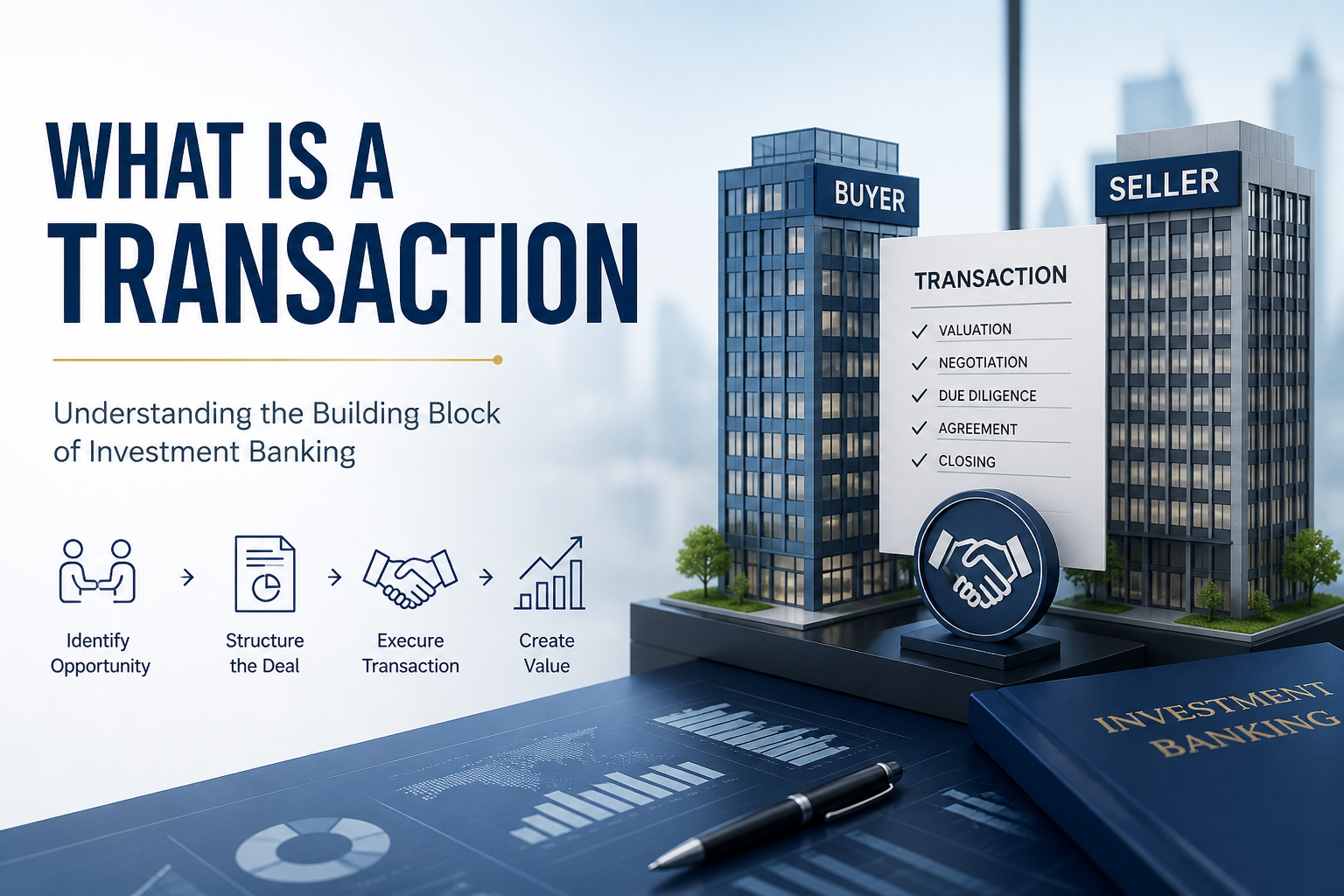
Regardless of whether a transaction is M&A or capital markets, the general arc tends to follow a similar pattern. First, there's origination — the bank wins the mandate to advise or execute. Then comes structuring and preparation — building financial models, drafting prospectuses, conducting due diligence, and determining the right strategy. Next is execution — actually going to market, running an auction process, pricing a bond, or launching an IPO. Finally, there's closing — signing the documents, transferring ownership or funds, and popping the proverbial champagne.Each stage requires different skills. Origination demands relationship-building and commercial instinct. Preparation demands analytical rigour and attention to detail. Execution demands market awareness and the ability to operate under pressure. And closing demands legal precision and coordination across multiple parties and jurisdictions.Why Should I Care?
If you're considering a career in finance, understanding what a transaction is — and the ecosystem that surrounds it — is foundational. Every analyst presentation, every late-night model, every pitch book you'll ever build exists in service of one thing: getting a transaction done well. Whether you end up in M&A, ECM, DCM, leveraged finance, or somewhere else entirely, you'll be working on transactions. The flavour will differ, but the core purpose remains the same: helping clients navigate complex, high-stakes financial events to achieve the best possible outcome.So the next time someone in a suit casually mentions they're "working on a transaction," you'll know exactly what they mean — and, more importantly, why it matters. Transactions are the heartbeat of investment banking. Everything else is just preparation for the next one.


So... WTF is a Transaction?
by Canary Wharfian
February 11th 2026
Join the conversation
You've probably heard the word "transaction" thrown around like confetti at a trading floor celebration. But what does it actually mean? Not in the dictionary sense — in the real, practical, "this is what bankers actually do" sense. Let's break it down.
The Simple Version
A transaction is a major financial event where a company buys, sells, combines, or raises something of value — like ownership or capital — generally for strategic reasons. Put another way, it is a major event in a company's life, the equivalent of a person buying a house, borrowing money, or selling their car. These are not everyday occurrences. They are defining moments that reshape what a company is, what it owns, and how it funds its future.When people in investment banking say they "work on transactions," they mean they are advising on or executing one of these landmark events. It might be helping a tech startup go public, advising a pharmaceutical giant on acquiring a competitor, or structuring a billion-pound bond issuance for a sovereign government. The common thread is that something significant is changing hands — ownership, capital, risk — and professionals are brought in to make sure it happens smoothly, efficiently, and on the best possible terms.Why Do Companies Need Help?
For major decisions where large amounts of money and value are at stake, decision-makers commonly seek advice. That's intuitive — you wouldn't perform surgery on yourself, and you probably wouldn't sell a billion-pound business without expert guidance either. The larger the transaction, the more specialised that advice tends to be. Why? Because marginally improving the result of a transaction with specialist expertise is enormously valuable.Consider this: it's not worth spending £1 million on advisors to sell a £3 million house, because they are unlikely to add value in excess of their fees. But if you are selling a business worth £1 billion, and your £1 million advisor could improve the terms of the sale by just 1%, they could generate £10 million in value for their client. That's a high-return investment in quality advice for the business owner. This is precisely why investment banks exist — and why they command the fees they do.The Two Big Buckets: M&A and Capital Markets
Broadly speaking, transactions in investment banking fall into two major categories: mergers and acquisitions (M&A) on one side, and capital markets on the other.M&A is what most people picture when they think of investment banking. One company buying another. Two firms merging. A private equity fund taking a business private. These are advisory-driven transactions where bankers help clients navigate the strategic, financial, and procedural complexity of combining or separating businesses.Capital markets, on the other hand, is a different beast entirely — and one that often flies under the radar despite being equally critical. While mergers and acquisitions advisory often dominates perceptions of investment banking, capital markets represents a substantial and distinct area of the industry. Capital markets teams sit at the intersection of corporate advisory and financial markets, helping companies access funding by issuing securities to investors. Unlike M&A, where bankers advise on buying or selling businesses, capital markets professionals help clients raise capital by issuing equity or debt, or more structured securities with some characteristics of both.Capital Markets: Where Companies Meet Investors
This work requires a deep understanding not only of corporate finance and valuation, but also of investor appetite, market conditions, pricing dynamics, and the mechanics of securities issuance. In other words, it's not enough to know what a company is worth — you also need to know what investors are willing to pay, when the market window is right, and how to structure an offering that satisfies both issuer and buyer.Capital markets teams operate in close collaboration with both internal colleagues in sales and trading and external investors, making the role more market-facing and fast-paced than traditional advisory. If M&A is a chess match — deliberate, strategic, played over months — then capital markets can feel more like a sprint, with tight execution windows and real-time market sensitivity.The three main areas within capital markets are Equity Capital Markets (ECM), Debt Capital Markets (DCM), and Leveraged Finance, each with distinct characteristics, client bases, and skill requirements. ECM helps companies raise money by selling shares — think IPOs, follow-on offerings, and rights issues. DCM focuses on debt issuance — investment-grade bonds, government securities, and other fixed-income instruments. Leveraged Finance sits at the intersection, dealing with higher-risk, higher-yield debt typically used to fund acquisitions or buyouts.Alright... So What Does Actually Happen in a Transaction?
Regardless of whether a transaction is M&A or capital markets, the general arc tends to follow a similar pattern. First, there's origination — the bank wins the mandate to advise or execute. Then comes structuring and preparation — building financial models, drafting prospectuses, conducting due diligence, and determining the right strategy. Next is execution — actually going to market, running an auction process, pricing a bond, or launching an IPO. Finally, there's closing — signing the documents, transferring ownership or funds, and popping the proverbial champagne.Each stage requires different skills. Origination demands relationship-building and commercial instinct. Preparation demands analytical rigour and attention to detail. Execution demands market awareness and the ability to operate under pressure. And closing demands legal precision and coordination across multiple parties and jurisdictions.Why Should I Care?
If you're considering a career in finance, understanding what a transaction is — and the ecosystem that surrounds it — is foundational. Every analyst presentation, every late-night model, every pitch book you'll ever build exists in service of one thing: getting a transaction done well. Whether you end up in M&A, ECM, DCM, leveraged finance, or somewhere else entirely, you'll be working on transactions. The flavour will differ, but the core purpose remains the same: helping clients navigate complex, high-stakes financial events to achieve the best possible outcome.So the next time someone in a suit casually mentions they're "working on a transaction," you'll know exactly what they mean — and, more importantly, why it matters. Transactions are the heartbeat of investment banking. Everything else is just preparation for the next one.Careers
Resources


JobsInterview PrepHireVue/Pymetrics GamesPsychometric TestsGenerate ApplicationApplication TrackerCompany DirectoryInterview ReviewsSalariesPodcastGlossaryMarkets TrackerNetworking AgentExcel Financial ModelingConsulting Case PrepCFA Exam PrepMBA Interview PrepGMAT Exam PrepTechnical QuizzesAboutBecome a Brand AmbassadorContact UsPrivacy PolicyTerms & Conditions
© 2026 Canary Wharfian. All Rights Reserved.